
Unsere Partner







References
Where Practice Speaks for Itself
Difficult conversations cannot be learnt by heart – whether in the classroom or in a client meeting.
Our references come from the field of education. The principle behind them applies everywhere: those who wish to remain capable of acting in challenging situations need a confidence that can be developed in safe experiential spaces. Without an audience. Without risk. With direct feedback.
Education
Digital Makerspace
Prof. Dr. Michael Schratz (University of Innsbruck) did not simply want to explain his concept of a "learning-oriented stance" – he wanted to make it tangible. The question: Can an AI show teachers how pupils respond when they feel truly seen? Or when they don't? The result is another bot for the intus³ beziehungslernen training programme of the Helga Breuninger Stiftung, which is being used as an AI continuing professional development tool for teachers in Germany, Austria, Switzerland, Italy (South Tyrol) and Thailand.
What's inside:
- 3 virtual pupils with their own personalities: Brian, Amira, Elias
- 3 bot variants: Topic Bot, Project Bot, Resistance Bot
- Game challenges across 3 progressively structured spaces in which emotional intelligence, applied knowledge and creativity / improvisation lead to success.
- Intervention jokers as a pedagogical mentor when needed
Teachers experience first-hand how young people respond to reprimand, instruction or appreciation. The training demands curiosity and a willingness to experiment – yet remains playful. Mistakes are not a risk, but the driving force behind development.
If you would like to look behind the scenes and learn more about how the Digital Makerspace came to be:
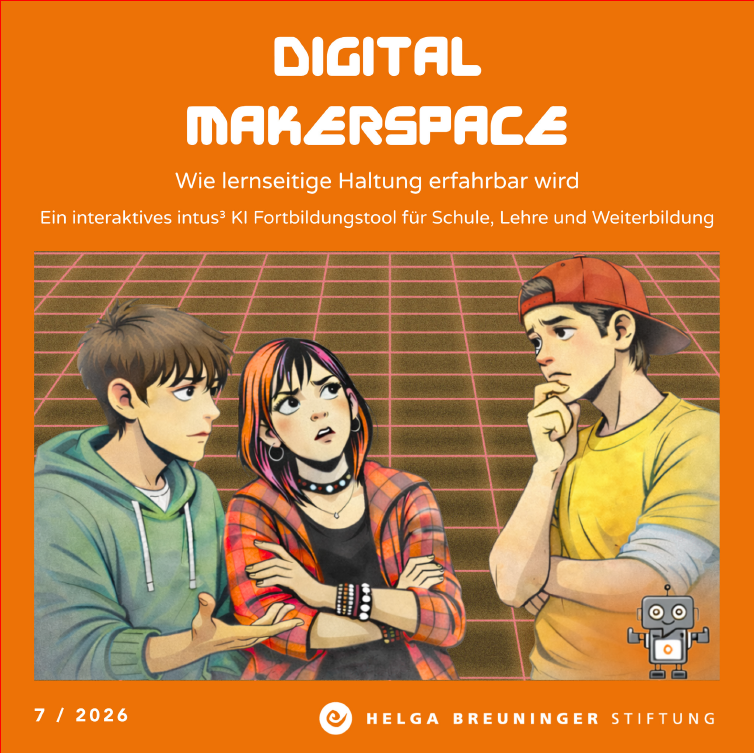
Making of: How the "Digital Makerspace" Came to Be
Dr. Helga Breuninger had a clear vision: she wanted to enrich the intus³ AI offering with an additional expert bot. To this end, she brought Prof. Dr. Michael Schratz (University of Innsbruck) on board – the founder of the Lernseits theory – and introduced him to graduate educationalist Maya Hamdy. Maya had already successfully developed the AI bot fleet for the intus³ offering and was curious about Michael's vision. Helga recalls: "Michael wanted something new – not to convey didactic instructions as books or training courses do, but to design something that could be experienced." For Maya, this was a very open and abstract brief. She decided to dig deeper and introduced Michael to her work, in which she had already developed role-play and escape room bots. By showing him what is possible today with AI bots, an idea gradually took shape through dialogue: the interaction between teacher and pupils should unfold in a sequence of responses and replies that continually relate back to one another, thereby triggering development. "The user should interact with pupils without knowing how they will respond," said Michael, whereupon Maya sighed: "What you actually want is a human being…" She had put his concern into words precisely. Maya pondered and murmured half to herself: "…then I'd have to build a human being," at which Michael burst out laughing. Maya clarified: "Of course that's not possible, but we can simulate a human being." Her ambition was to engage with something that could not be planned from the outset: an emerging, unplanned future. That was the beginning of their shared expedition.
From the very beginning, one thing was clear: for Maya, learning had to be fun. "If there's no element of play, I don't see any added value," she explained. For her, the playful aspect was not decoration, but the structure that makes experience possible. Michael did not want dry factual information, but an attitude that could be felt and lived. Maya summed it up: "We need a playful element in which you learn something without having it explained to you – simply by doing it."
Yet the path was anything but straightforward. With every increase in realism, there was a risk of losing the element of fun.
Maya suggested changing the setting. Instead of a classroom, the virtual pupils were to interact in a space that enables new forms of action. Michael introduced the idea of a "Makerspace" – a space for experimenting, tinkering and learning by doing. And so the "Digital Makerspace" was born.
Helga brought an expedition group on board. It consisted of experts from various areas of education – school leadership, inclusion, and teacher training and continuing professional development – who contributed valuable insights.
But then the teachers and professors criticised the fact that the pupils were too well-behaved and too quick to cooperate. Maya was initially sceptical, as for her the "Digital Makerspace" was meant to remain a space that fosters joy in learning – without the frustrations of everyday school life. Yet the criticism was clear, and Michael remained persistent. In the end, Maya decided: "All right, then I'll build you some genuinely resistant virtual pupils!"
Maya put everything into programming the bot in such a way that the pupils consistently challenge the teacher.
The result: the Resistance Bot. It quickly became the audience favourite. Teachers reported: "I really had to make an effort, but it was fun." The bot brought reality into play without losing its playful character. Maya had created a bot that offered the perfect balance between challenge and enjoyment.
The result was three bots with different approaches:
- Topic Bot: The development of any chosen subject.
- Project Bot: Development of projects.
- Resistance Bot: Engaging with and managing highly challenging pupils.
All three bots share the same goal: they create an experiential learning and reflection environment that offers teachers the opportunity to master challenging situations, test their own approaches and develop new strategies, without affecting real pupils.
The Digital Makerspace is a safe space in which teachers can try out new approaches, learn from reactions and transfer their insights into practice.
Michael summed it up: "In the Makerspace, I dared to do something I would never do in reality. I sat down on the floor and watched what happened. And suddenly I found the courage to try it out in a real classroom too."
Helga summed it up: "That is what you have achieved, Maya. You have created a space that awakens courage, curiosity and a joy of experimentation."
Education
intus³ AI
The life's work of a psychologist and education expert embodied in six bots.
Dr. Helga Breuninger wanted to make her attitude and coaching concept interactively tangible. The question: How do you bring 40 years of experience in relational learning into an AI without losing the human warmth?
Using the AI Soulmaker® method, six bots were created and users say: "I had the feeling I was speaking with Helga Breuninger herself."
That was the plan.
AI-powered training programme "intus³ beziehungslernen"
6 Bots. From the "Potenzialblick " and "Haltung" through to the "KI Coach".
4 Roles. "Potenzialblicker", "KI Coach", "Trainingsbots für Beziehungslernen", "Haltungswechsler"
24/7 available. No appointment, no waiting time.
Questions instead of instruction. Self-reflection instead of directives.
The bots are available to teachers at any time – as a complement to seminars or for everyday reflection. Challenging situations become learning opportunities.
The projects shown here make possibilities visible. Perhaps you recognise parallels to your own topics – or perhaps an idea is just beginning to take shape.
Either way, it is a good starting point.
 German
  English